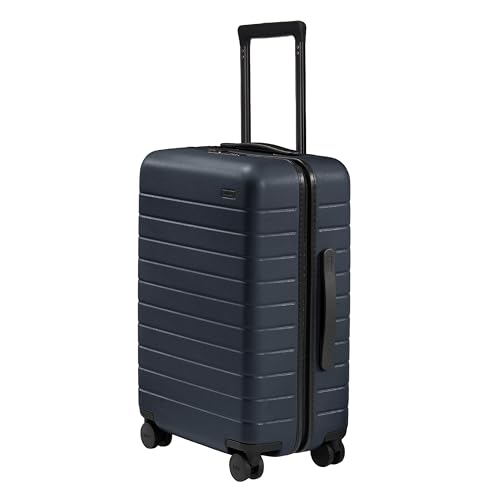
By Emily Parker
Updated November 2026
Carry on luggage rules American Airlines sets are straightforward once you know where to look: a maximum bag size, a single personal item that fits under the seat in front of you, and a general expectation that your carry-on fits in the overhead bin. This guide walks you through the dimensions, the factors that can get a bag gate-checked, how to measure and test your luggage before you travel, and the mistakes travelers make most often. By the end, you should know whether your current bag qualifies and what to do if it doesn’t.
American Airlines Carry-On Size Limits
American’s published limit for a standard carry-on is 22 x 14 x 9 inches (56 x 36 x 23 cm), measured including wheels, handles and any exterior pockets or protrusions. Bags at or under that measurement are the baseline most travelers aim for. Because the airline’s rules can change and the figure above is the widely cited standard, always check the current carry-on page on aa.com before you buy a new bag or book a fare that depends on it.
Shopping for one? See our guide: Protege Carry On Luggage: 7 Best Picks for Airline Size Limits (2026).
Keep in mind that the carry-on size limit is not the same as the overhead bin fit. Some aircraft have smaller bins, and some bags with the correct external dimensions still don’t slide in easily because of soft sides that bulge, wheel housings that stick out, or handles that stay extended. A bag that technically meets the size limit can still be gate-checked if a flight attendant decides the bins are full.
Personal Item Rules and What Counts
In addition to a carry-on, American allows one personal item that must fit under the seat in front of you. Airlines typically cite a size near 18 x 14 x 8 inches for personal items, but many travelers use a backpack or small tote that is clearly smaller than that. The safest approach is to treat the personal item as something that goes entirely under the seat with no part sticking into the aisle.
Common personal items include a laptop bag, a purse, a small backpack or a camera bag. A purse that is oversized or a backpack stuffed well beyond its normal shape may be counted as a carry-on, so keep the personal item compact.
How to Check Whether Your Bag Qualifies
Measuring before you leave home saves time at the gate. Use the following steps to confirm your bag meets the standard.
- Empty the bag completely and extend any telescoping handles to their normal travel position.
- Measure height from the bottom of the wheels to the top of the highest handle or point, using a soft tape measure.
- Measure width across the widest part, including side pockets or zippered expansions that are closed.
- Measure depth from the front face to the back face, including any bulge when the bag is packed to its normal level.
- Compare each figure to 22 x 14 x 9 inches and leave a little margin, since a fully packed bag can grow.
- Pack the bag as you would for travel and test whether it closes without strain and stands upright.
For a deeper look at fit and measuring technique, see 22 X14 X9 Carry On Luggage: Airline Limits, Fit Tips and How to Measure.
Weight Limits and Packing Considerations
American does not publish a strict weight limit for carry-on bags the way it does for checked luggage, but very heavy carry-ons are harder to lift into bins and can be questioned at the gate. Packing a bag that stays comfortably under about 20 pounds (9 kg) makes it easier to handle, and it reduces the risk of straining your back on crowded jet bridges. If you need to check a bag because of weight or bulk, plan for that at booking rather than at the gate.
Also consider what you pack that can be restricted. Lithium batteries, liquids over the TSA 3.4-ounce limit in carry-on bags, and certain sharp items have rules that apply regardless of size, so verify them against TSA and American guidance before you pack.
Choosing a Bag That Fits the Rules
Hard-sided and soft-sided bags both can meet the limit. Hard shells usually keep their exact dimensions, which is convenient for bin fit, while soft-sided bags often compress slightly and can slide in more easily. Four-wheel spinners are easy to maneuver through the terminal, and two-wheel rollers can be sturdier on uneven pavement. Whichever style you choose, make sure the listed dimensions include wheels and handles, since some manufacturers list only the body.
Browsing the related guides can help you compare options within the same size class. Carry On Luggage for Southwest Airlines: Size Limits and Tips (2026) shows how another carrier’s limits compare, and Carry-On Luggage American Airlines: Size Limits and Tips for 2026 covers additional sizing scenarios. For tight overhead bins, Carry On Underseat Luggage: Sizes, Fit and Airline Rules (2026) is useful if you fly small regional jets.
Recommended gear
- Soft flexible tape measure: A tape that bends around handles and wheels gives more accurate results than a rigid ruler, so you can measure a fully assembled bag. View on Amazon
- Luggage scale: A handheld digital scale lets you check total bag weight before you reach the check-in counter or gate. View on Amazon
- Packing cubes: Organized cubes keep the bag from bulging, which helps it stay within its measured dimensions. View on Amazon
Common Mistakes
- Measuring only the bag body and forgetting wheels, handles and exterior pockets.
- Packing a bag so full that it bulges beyond its rated dimensions.
- Assuming a bag that fit on one airline will fit the same bins on every aircraft type.
- Carrying a second bag that looks like a carry-on instead of a true personal item.
- Relying on an old policy screenshot instead of checking current rules before the trip.
Tips for a Smooth Gate Experience
- Board early if your fare includes it, since bins fill quickly on full flights.
- Keep valuables and medications in your personal item rather than the carry-on.
- Remove or secure loose straps and tags so the bag slides in cleanly.
- If the gate agent asks you to check the bag, ask about any fee or waiver tied to your status before you agree.
FAQ
What is the American Airlines carry-on size limit?
American’s standard carry-on limit is 22 x 14 x 9 inches, including wheels and handles. Always confirm the current figure on the airline’s website before you travel.
Does American Airlines have a carry-on weight limit?
American does not publish a strict weight limit for carry-ons, but keeping the bag under roughly 20 pounds makes it easier to lift into the bins.
How big can a personal item be on American?
A personal item must fit under the seat in front of you. Airlines commonly reference about 18 x 14 x 8 inches, so a small backpack or tote is the safest choice.
Can I bring two carry-on bags on American Airlines?
Standard economy passengers are generally allowed one carry-on plus one personal item. Premium cabins and some elite tiers may have different allowances, so check your fare rules.
Will my carry-on be gate-checked if the bins are full?
It can be. Gate agents may check bags at the door when overhead space runs out, so boarding early improves your odds of keeping the bag with you.
Do wheels and handles count toward the size limit?
Yes. American measures bags including wheels, handles and exterior pockets, so measure the complete bag rather than the body alone.
Are carry-on rules the same for international flights?
Not always. Partner airlines, international routes and regional aircraft can have different limits, so check the rules for your specific itinerary.
Conclusion
Carry on luggage rules American Airlines enforces center on a 22 x 14 x 9 inch carry-on, one personal item that fits under the seat, and a practical expectation that your bag fits the bins. Measure your bag with its wheels and handles in place, pack it so it does not bulge, and confirm current policy before you fly. A few minutes of preparation at home is the best protection against a gate-check surprise.
Ready to choose one?
About Emily Parker
Emily Parker is part of our editorial team and reviews and edits our luggage & travel tech guides, checking product details against manufacturer specifications and owner feedback.