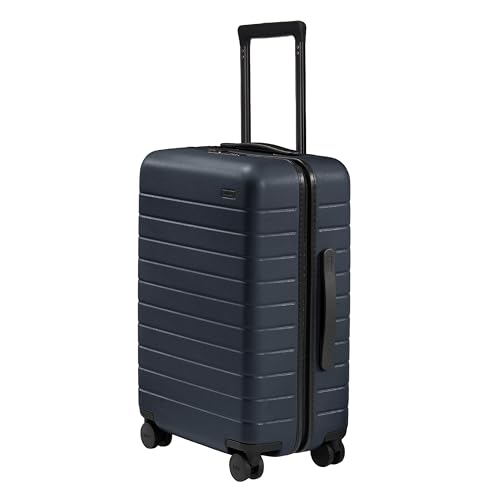
By Emily Parker
Carry-on luggage American Airlines passengers can bring on most domestic and international flights is governed by a size and weight standard that you can check in about two minutes. This guide walks you through the dimensions American publishes, how to measure your bag accurately, how to pick a case that fits, and the habits that keep you from being asked to gate-check it at the last minute. By the end, you will know whether your current bag qualifies and what to look for if it does not.
Understand American Airlines’ Carry-On Size Limit
American Airlines uses a combined linear dimension measurement for carry-on bags, adding length, width and height together. The company’s published guidance for standard carry-ons is a maximum of 22 x 14 x 9 inches, which totals 45 linear inches including wheels and handles. Those are the outside measurements, so a case that is labeled 22 inches on the tag but measures 23 inches once the handle is extended will not pass a sizer.
Weight is handled differently. American does not set a firm weight cap for carry-ons on most fares, but the bag still has to be something you can lift into the overhead bin without help. Many travelers aim for 15 to 18 pounds fully packed as a practical ceiling, and a bag over 20 pounds becomes difficult to manage in a crowded aisle. Check your fare type and any current policy on the airline’s website before departure, since rules can differ by route and by aircraft.
Measure Your Bag the Right Way
Most people measure a bag incorrectly because they stop at the main body and forget the rest of the case. Do the measurement with the bag empty and the handle fully retracted, then work through the steps below.
- Stand the bag upright on a hard floor with all wheels touching the ground.
- Measure height from the floor to the highest point of the case, including the top handle and any protruding wheel housing.
- Measure width from the widest side-to-side point, including side pockets, zippers and any bumpers.
- Measure depth from the front face to the back, including corner guards and the expanded zipper section if the case has one.
- Add the three numbers and compare the total to 45 inches.
- Repeat with the expansion zipper fully closed. Expandable bags often exceed the limit when opened.
A flexible tape measure works better than a rigid ruler for soft-side cases, because the fabric can bulge under pressure. Measure at the widest point rather than the average, and round up if you are within half an inch of a limit.
Watch for Expansion and Overpacking
Soft-side bags with expansion zippers are the most common reason a carry-on fails at the gate. A case may pass when empty, then bulge past the limit once it is full. Keep the expansion closed when you travel and avoid packing so tightly that the walls push outward. If your bag has a compression strap, use it to keep the sides flush.
Choose a Bag That Fits the Limit From the Start
If you are buying new luggage specifically for carry-on use, look for a case whose outside dimensions sit comfortably under 22 x 14 x 9 inches. Leaving a half-inch of margin on each side accounts for wheel housings, handles and manufacturing tolerances. Manufacturers often list the nominal size on the tag, and the true outside size can run a little larger, so verify with a tape measure rather than trusting the label.
Hard-shell and soft-side cases each have trade-offs. Hard shells keep their shape and resist crushing in a tight bin, while soft sides often compress slightly and can squeeze into space that a rigid case cannot. For a deeper comparison of materials and wheel types, see Spinner vs Two-Wheel Luggage: Which Rolls Better for Your Trips? and Soft-Side Luggage: Fabrics, Expansion and Pockets.
Consider Wheel Height and Handle Design
Four-wheel spinners add height in exchange for better maneuverability. Two-wheel cases sit lower and often measure a little smaller on the same internal volume. Telescoping handles are a frequent source of extra inches, so check whether the handle lies flat when retracted.
Plan Your Packing So the Bag Stays Carry-On Legal
Even a bag that measures correctly can get flagged if it is packed in a way that makes it bulge or if it is too heavy to lift. A few packing habits keep things under control.
- Place heavy items such as shoes and toiletry bags near the wheels, where the case is strongest.
- Fill the center with soft clothing and use it to fill gaps rather than forcing rigid items.
- Roll garments instead of folding them to reduce depth.
- Keep the expansion zipper closed and the compression straps snug.
- Weigh the bag on a bathroom or luggage scale before you head to the airport.
If you travel with a laptop, keep it in an accessible personal item such as a backpack or tote, which does not count against your carry-on allowance on most fares. For a broader list of organizers and add-ons, see Carry-On Accessories Checklist.
Know What Happens at the Gate
Gate agents can check a bag at the boarding door if the overhead bins are full. Passengers in earlier boarding groups usually get the most bin space, so a later boarding group is more likely to see their bag gate-checked. Keep valuables, medication and any essentials in your personal item so you are never separated from them. Remove any loose items such as chargers or travel pillows from the outside pockets before you reach the jet bridge.
Check the Fare Rules for Your Ticket
Basic economy fares sometimes come with tighter carry-on rules than main cabin or premium tickets, and some international routes have different allowances. Read the baggage section of your booking confirmation and compare it to the airline’s current policy page. If anything is unclear, contact American directly before you travel.
Common Mistakes to Avoid
- Trusting the size printed on the manufacturer tag instead of measuring the actual case.
- Forgetting to include wheels, handles and expansion zippers in the total.
- Overpacking to the point where the shell bows outward.
- Assuming a bag that fit on a previous airline will fit American’s limits without checking.
- Putting valuables or medication in a bag that might be checked at the gate.
Tips for Staying Under the Limit
- Measure your bag once a year, since wheels and handles can wear and change shape.
- Use a packing cube system so clothing stays compressed and organized.
- Choose a bag with a slim profile if you often fly on regional aircraft with smaller bins.
- Board early if you can, since bin space is most available for the first groups.
Recommended Gear
A few supporting items make it easier to confirm size and weight before you reach the airport.
- Flexible tape measure: Works well on soft-side cases and lets you measure wheels and handles accurately. View on Amazon
- Portable digital luggage scale: Lets you weigh a packed bag at home so you know it is manageable before check-in. View on Amazon
- Packing cubes: Compress clothing and reduce bulk, which helps soft-side bags stay flat. View on Amazon
- Compression straps: Keep the case from bulging when it is full and help it stay within the measured limit. View on Amazon
FAQ
What is the carry-on size limit for American Airlines?
American’s standard carry-on guidance is 22 x 14 x 9 inches, which totals 45 linear inches including wheels and handles. Measure your bag with the handle retracted and the expansion closed to confirm.
Does American Airlines have a carry-on weight limit?
American does not typically enforce a firm weight limit for carry-ons on most fares, but the bag must be manageable to lift into the overhead bin. Many travelers keep bags under about 18 pounds.
Are wheels and handles included in the measurement?
Yes. The linear measurement includes wheels, handles and any protruding parts, so a bag may exceed the limit even if the main body fits.
Can I bring a backpack as well as a carry-on?
Most fares allow one carry-on bag plus one personal item, such as a backpack or tote that fits under the seat. Confirm the rules for your specific fare type before you fly.
What happens if my carry-on is too big?
Gate agents may ask you to check the bag at the boarding door, and fees can apply depending on your fare and route. Measuring before you travel avoids this.
Do expandable bags count as larger when expanded?
Yes. Measure the bag with the expansion closed, since opened expansion sections often push the case past the limit.
Do I need a different bag for international flights with American?
Size rules can vary by route and aircraft, so check the policy for your specific itinerary. For guidance on bags suited to longer trips, see Choosing Luggage for International Flights.
Conclusion
Carry-on luggage American Airlines travelers can count on comes down to measuring the full outside dimensions, staying close to 22 x 14 x 9 inches, and packing in a way that keeps the case flat and manageable. Check your fare rules before departure, keep essentials in your personal item, and board early when you can. A few minutes of measuring at home is usually enough to avoid a gate-check surprise.
Related reading
Ready to choose one?
About Emily Parker
Emily Parker is part of our editorial team and reviews and edits our luggage & travel tech guides, checking product details against manufacturer specifications and owner feedback.