Some links on this page are affiliate links. If you buy through them, we may earn a commission at no extra cost to you. As an Amazon Associate I earn from qualifying purchases. Learn more ›
Best Compact Cameras for Travel
Compare compact travel cameras by sensor size, zoom range, video features and battery charging, based on manufacturer listing specs rather than hands-on testing.
This post contains Amazon affiliate links. As an Amazon Associate I earn from qualifying purchases, at no extra cost to you.
Travelers who want a camera that fits in a day bag usually weigh a few things: how much zoom they need for distant subjects, how large the sensor is for low light, whether they want to shoot video, and how the battery charges. The seven cameras below cover a range of those priorities, from basic point-and-shoot models to pocket vlogging cameras with motorized stabilization.
We chose these picks by comparing listing specifications and feature descriptions. We have not tested any of these cameras by hand, so treat the notes below as a summary of what each listing states. Check each listing for current price, availability and full details before you buy.
AI score rating is a scoring system developed by our experts. The score is from 0 to 10 based on the data collected by the AI tool. This score doesn't impact from any manufacturer or sales agent websites. Learn more ›
The Kodak PIXPRO FZ55 is a simple 16MP point and shoot camera with a 5x optical zoom, 28mm wide angle lens, and 1080p video recording in a slim, pocket-sized body. It suits casual shooters, families, and beginners who want straightforward controls and everyday travel photos without the complexity of an interchangeable lens camera.
Pros & Cons
Pros
Compact, lightweight design makes it easy to carry everywhere
Versatile 5x optical zoom and wide angle lens cover a broad range of scenes
Simple, beginner-friendly controls with automatic and program modes
Affordable price point for a feature-rich point and shoot camera
Strong customer satisfaction with a 4.4 out of 5 average rating
Cons
Relies on digital image stabilization rather than optical stabilization, which may blur shots in low light or at full zoom
Video is limited to 1080p, so it does not offer 4K recording for higher-resolution footage
Small 1/2.3-inch sensor and 2.7-inch fixed LCD may limit low-light performance and detailed image review
Detailed Review
The Kodak PIXPRO FZ55 is a compact point and shoot camera built for everyday photography. It suits families, casual travelers, and beginners who want a camera that works without a learning curve. Its simple design keeps the focus on capturing moments rather than adjusting settings.
The 5x optical zoom paired with a 28mm wide angle lens gives you flexibility for both distant subjects and sweeping landscapes. The 16MP CMOS sensor produces clean, detailed images in good daylight, and the 1080p Full HD video mode handles short clips and basic vlogging well. Shooting modes including Automatic, Landscape, Macro, and Portrait help you adapt to common situations quickly.
The body is slim and light, so it slides easily into a pocket or small bag for spontaneous shooting. The fixed 2.7-inch LCD is bright enough for reviewing images and changing settings, and the controls are laid out in familiar, uncomplicated menus. The rechargeable battery charges over USB and offers roughly 200 shots per charge, though a full charge of at least four hours is recommended before first use.
Digital image stabilization is the main limitation, as it cannot match optical stabilization for sharp results in dim conditions or at maximum zoom. Video tops out at 1080p, and the small sensor will show more noise than larger-sensor cameras in low light. Photographers looking for manual control or interchangeable lenses should consider a more advanced model.
For its price, the FZ55 is a practical, no-fuss camera that delivers reliable results in good lighting. If you want an easy-to-carry camera for trips, family events, and casual creative projects, it is a sensible choice. Its strong user rating reflects its simplicity and everyday usefulness.
AI score rating is a scoring system developed by our experts. The score is from 0 to 10 based on the data collected by the AI tool. This score doesn't impact from any manufacturer or sales agent websites. Learn more ›
The Sony RX100 VII is a pocket-sized camera with a 1.0-type stacked CMOS sensor, a 24-200mm Zeiss zoom, and up to 20 fps blackout-free shooting. It suits travelers, vloggers, and enthusiasts who want DSLR-level autofocus and 4K video in a jacket pocket.
Pros & Cons
Pros
Large 1.0-type sensor delivers noticeably better image quality than typical compact cameras
Versatile zoom range from wide-angle to telephoto in a single pocketable body
Excellent autofocus speed and subject tracking for action, wildlife, and portraits
Strong 4K video features including log recording, stabilization, and a microphone input
Cons
Premium pricing puts it well above most compact cameras, so budget buyers may prefer alternatives
The small body and compact controls can feel fiddly for users with larger hands
Battery life is limited for extended shooting or long video sessions, so spare batteries are recommended
Detailed Review
The Sony RX100 VII is a premium pocket camera built around a 20.1MP 1.0-type stacked CMOS sensor and a 24-200mm Zeiss zoom lens. It is aimed at travelers, content creators, and enthusiasts who want high image quality without carrying an interchangeable-lens kit.
Autofocus is the standout feature, with a 0.02-second acquisition time and a hybrid system of 357 phase-detect and 425 contrast-detect points. Real-time tracking and eye AF for people and animals hold subjects steady, and the 20 fps burst mode with blackout-free viewing makes fast action easier to capture.
The body is compact and well machined, with a tilting screen and a pop-up electronic viewfinder that make shooting from unusual angles practical. Controls are numerous but small, so the camera rewards users who take time to customize its buttons and menus.
Limitations include a relatively high price, a modest battery life that calls for spares on long days, and a small grip that some photographers will find awkward. The fixed zoom also means no lens swapping, which may matter for specialized work.
For photographers who want the best possible image quality in the smallest practical package, the RX100 VII remains one of the strongest compact options available. It is an excellent choice for travel, street, and everyday creative work, though buyers on a tight budget should weigh the cost carefully.
AI score rating is a scoring system developed by our experts. The score is from 0 to 10 based on the data collected by the AI tool. This score doesn't impact from any manufacturer or sales agent websites. Learn more ›
The SMARTKLIK 4K vlogging camera is a compact point and shoot model with a 3-inch 180° flip screen, 75MP effective stills, WiFi transfer, and webcam support. It suits beginners, teens, and casual vloggers who want an all-in-one kit with a 64GB card and two batteries included.
Pros & Cons
Pros
Very approachable for beginners with easy shooting modes, a framing grid, and smart autofocus
Includes a 64GB SD card, two batteries, and a USB-C cable, reducing the need for extra purchases
Flip screen and WiFi make self-recording and quick phone transfers convenient
Lightweight compact body at about 226 g that fits easily into a bag for travel
Competitive price point for a 4K camera with multiple accessories included
Cons
The 16X zoom is digital rather than optical, so fine detail softens noticeably at long range
Image quality in low light is limited by a small 1/4-inch sensor and a maximum ISO of 3200
The camera is not water resistant and its 3-inch LCD is small for detailed manual adjustments
Detailed Review
The SMARTKLIK 4K Digital Camera is a compact point and shoot model built for beginners, teens, families, and casual content creators who want simple controls and a complete starter kit. It arrives with a pre-installed 64GB SD card, two rechargeable batteries, and a USB-C cable, so you can start recording right away without buying accessories.
Its standout features are 4K video, 75MP effective stills, and built-in anti-shake that keeps handheld walking shots and vlogs steadier than you would expect from a camera at this price. The 3-inch 180° flip screen makes self-framing easy, and the framing grid and smart autofocus help newcomers get sharp results with minimal setup. Creative extras such as time-lapse, slow motion, continuous shooting at 3 frames per second, and over 20 filters add fun for family outings.
The body is lightweight at roughly 226 g and has a compact, straightforward design that suits travel and everyday carry. Connectivity is a practical strength: WiFi lets you transfer photos and control the camera from a smartphone, while PC webcam support, HDMI output, a 3.5mm mic socket, and a hot shoe give you room to grow. The build is plastic and the camera is not water resistant, so it is best kept away from rain, sand, and heavy handling.
The main drawback is that the 16X zoom is digital, which means distant subjects lose detail quickly compared with an optical zoom lens. Low-light performance is also limited by the small 1/4-inch sensor and a maximum ISO of 3200, so indoor or night shots may look grainy. Buyers expecting DSLR-level control or pro-grade low-light results should look at larger-sensor models.
Overall, this SMARTKLIK camera offers excellent value for beginners and families who want 4K video, flip-screen vlogging, and easy sharing in one affordable kit. With a 4.1 out of 5 rating from buyers, it earns a recommendation for everyday recording and entry-level content creation, provided you accept its digital zoom and modest low-light limits.
AI score rating is a scoring system developed by our experts. The score is from 0 to 10 based on the data collected by the AI tool. This score doesn't impact from any manufacturer or sales agent websites. Learn more ›
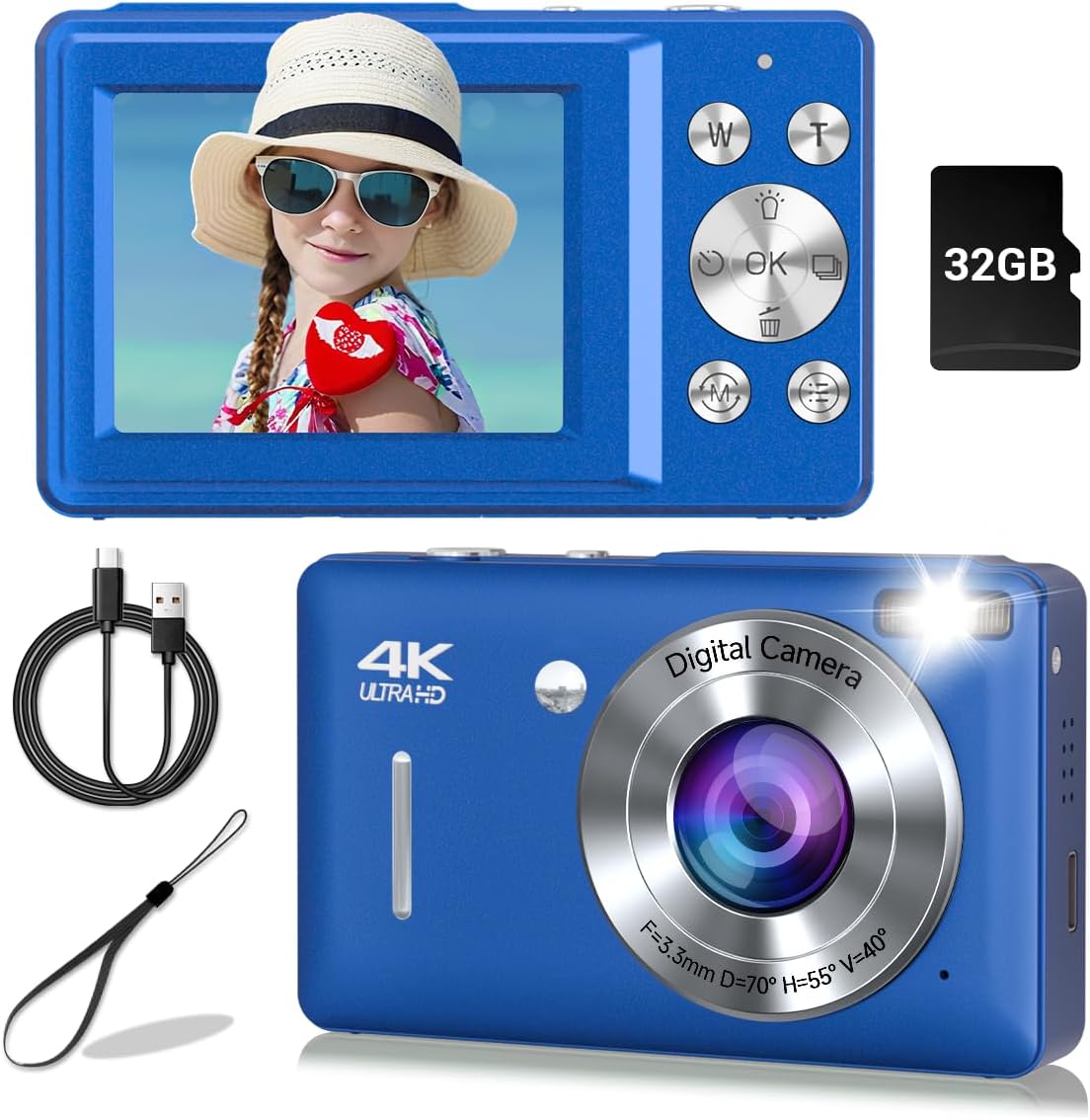
The Gtonster Blue 44MP compact camera is a simple point-and-shoot designed for kids, teens, and beginners who want an easy first camera. Its smile capture, face detection, and anti-shake features make it well suited to casual family photos and travel snapshots.
Pros & Cons
Pros
Very easy to use, making it a practical first camera for kids and beginners
Smile capture and face detection simplify focusing and reduce missed moments
Lightweight and portable, suitable for travel and everyday carrying
Affordable entry point with useful extras like filters, a self timer, and a lanyard
Cons
The 16X zoom is digital, so image quality softens noticeably at higher zoom levels
Image quality is best suited to casual use in good lighting rather than detailed or low-light photography
Video is limited to 1080p and the 44MP rating is an interpolated figure, so expectations should be modest
Detailed Review
The Gtonster Blue compact digital camera is a point-and-shoot built for kids, teens, and beginners who want an uncomplicated way to document everyday life. It works well as a first camera for a young photographer or as a travel companion for families who do not want to risk a smartphone or more expensive gear.
Its standout features are the smile capture and face detection tools, which automatically trigger the shutter when a subject smiles, helping younger users capture candid moments without mastering focus settings. The 16X digital zoom, W/T buttons, self timer, continuous shooting, and more than 20 fun filters add variety for everyday shooting. Anti-shake and fill light help images stay steady and brighter in dim conditions.
The camera has a compact, lightweight body, a fixed 2.4-inch LCD screen, and an included lanyard, so it is easy to carry and hard to leave behind on trips or outings. The controls are simple and the build feels appropriate for its price and audience, though it is plastic and not designed for rugged use. The included USB-C cable and battery make it ready to use out of the box.
The drawbacks are mainly related to image quality limits. The zoom is digital, so detail drops noticeably when zoomed in, and the 1080p video and marketed 44MP resolution should be viewed as modest compared with dedicated mirrorless or even current smartphone cameras. Performance in low light is adequate for casual shots but not for demanding scenes.
Overall, this is a sensible, budget-friendly camera for kids, teens, and beginners who want fun, easy photos in good lighting. Buyers looking for sharp zoomed images or advanced control should look at higher-end options, but as a gift or first camera, it delivers good value.
AI score rating is a scoring system developed by our experts. The score is from 0 to 10 based on the data collected by the AI tool. This score doesn't impact from any manufacturer or sales agent websites. Learn more ›
The Canon PowerShot V1 is a compact, video-first camera with a 16-50mm wide-angle zoom, a 1.4-type sensor, and a built-in cooling fan that supports longer high-resolution recording. It suits vloggers, live streamers, and content creators who want Canon Log 3 color and 4K video in a single pocketable body.
Pros & Cons
Pros
Cooling fan allows extended high-resolution shooting sessions
Wide-angle zoom lens is well suited to vlogging and close-range self-recording
Canon Log 3 and 10-bit color give strong flexibility for grading
Sensor-shift stabilization and articulating screen support handheld and selfie-style shooting
Compact body with Wi-Fi and Bluetooth makes it easy to share footage quickly
Cons
No electronic viewfinder, so bright sunlight can make the rear screen harder to use
Built-in flash is absent and the hot shoe is the only accessory mount, so lighting depends on external gear
Active cooling fan can add some noise and is a mechanical component to keep clean, which may matter for sensitive audio recording
Detailed Review
The Canon PowerShot V1 is a compact camera built around video, designed for vloggers, live streamers, and creators who want cinematic results without a full mirrorless setup. Its all-in-one body packs a 16-50mm wide-angle zoom into a sleek shape that is easy to carry on everyday shoots.
The standout feature is the built-in cooling fan, which helps the camera sustain high-resolution recording for longer than most compact models allow. Combined with sensor-shift stabilization, the V1 produces steady handheld footage, and the ultra-wide lens is well suited to self-filming and tight indoor spaces.
Build quality feels premium, and the articulating 3-inch LCD makes it easy to frame yourself or monitor a live stream from different angles. Canon Log 3 and 10-bit color give editors a flexible file to grade, though the camera still needs a bit of care in bright conditions since there is no viewfinder.
Potential buyers should consider the lack of a built-in flash and viewfinder, as well as the reliance on the hot shoe for any extra lighting or audio accessories. The fan is effective but adds a mechanical element that some users may notice in quiet environments.
Overall, the PowerShot V1 is a strong choice for content creators who prioritize video performance, extended recording times, and color flexibility in a portable package. It is less suited to photographers who need optical viewfinders or built-in lighting.
AI score rating is a scoring system developed by our experts. The score is from 0 to 10 based on the data collected by the AI tool. This score doesn't impact from any manufacturer or sales agent websites. Learn more ›
The Panasonic LUMIX ZS300 is a pocket-sized compact camera with a 1-inch 20.1MP sensor and a 15x optical zoom covering 24mm to 360mm. It suits travelers and event-goers who need telephoto reach and 4K video in a bag-friendly body without carrying an interchangeable lens system.
Pros & Cons
Pros
Compact, pocket-friendly body that fits easily in bags and lets you carry a long zoom everywhere.
Versatile 15x zoom range that handles wide landscapes and distant subjects with one camera.
Strong 4K video and photo capabilities with reliable stabilization for steady handheld footage.
Convenient smartphone sharing and charging via Bluetooth, Wi-Fi, and USB Type-C.
Good overall rating from owners for its everyday usability and image quality.
Cons
The 1-inch sensor is larger than a smartphone's but smaller than those in APS-C or full-frame cameras, so low-light and shallow depth-of-field results have limits.
The maximum aperture of f/3.3 at the telephoto end restricts background blur and light gathering when zoomed in.
The small 1025mAh battery and built-in flash range may require spare batteries or external lighting for long shoots or dim venues.
Detailed Review
The Panasonic LUMIX ZS300 is a compact travel camera built around a 1-inch 20.1MP sensor and a 15x optical zoom. It is aimed at travelers, concert-goers, and sports fans who want telephoto reach without the bulk of an interchangeable lens camera.
Its standout feature is the 24mm to 360mm Leica-standard zoom, which pulls distant subjects in with useful detail from a fixed, pocket-sized body. The 4K video and 30fps 4K photo modes capture fast action, and the advanced image stabilization keeps handheld footage and telephoto shots steady.
The body is designed to be easy to carry, slipping into bags or large pockets while still offering a 3-inch screen and electronic viewfinder for framing. Controls and quick startup make it responsive for spontaneous shooting, and the AF macro mode focuses as close as 1.18 inches at the wide end.
The main drawbacks come from its sensor size and lens speed. The 1-inch sensor performs well in good light but cannot match larger sensors in dim scenes or with background blur, and the f/3.3 maximum aperture narrows at telephoto. The built-in flash and modest battery capacity are also limitations for extended outings.
Overall, the ZS300 is a strong all-in-one choice for travelers and event-goers who value zoom range and 4K capability in a portable body. Buyers expecting studio-grade low-light performance should consider a larger sensor, but for everyday versatility it delivers solid value.
AI score rating is a scoring system developed by our experts. The score is from 0 to 10 based on the data collected by the AI tool. This score doesn't impact from any manufacturer or sales agent websites. Learn more ›
The DJI Osmo Pocket 3 Creator Combo is a compact vlogging camera with a 1-inch CMOS sensor, 4K 120fps video, and advanced 3-axis stabilization, ideal for content creators seeking professional-quality footage on the go.
Pros & Cons
Pros
Exceptional 3-axis stabilization for smooth, shake-free video in any scenario.
High-quality 4K 120fps video with a large sensor delivers professional results.
Rotating touch screen makes it easy to shoot both horizontal and vertical content.
ActiveTrack 6.0 ensures you stay in focus during dynamic movements.
Compact and portable design with useful accessories in the Creator Combo.
Cons
Battery life is limited without the included battery handle for extended sessions.
No built-in ND filter, which may require additional accessories for bright conditions.
Fixed lens limits versatility compared to interchangeable lens cameras.
Detailed Review
The DJI Osmo Pocket 3 Creator Combo is a powerful all-in-one vlogging solution designed for content creators who demand high-quality video in a portable package. With its 1-inch CMOS sensor and 4K 120fps recording, it excels at capturing smooth slow motion and detailed footage even in low light. This camera is perfect for travel vloggers, social media influencers, and anyone who wants professional-grade stabilization without a bulky setup.
Standout features include the rotating 2-inch touch screen, which allows you to switch seamlessly between horizontal and vertical shooting for platforms like YouTube and TikTok. The 3-axis mechanical stabilization is remarkably effective, eliminating shaky footage during active scenes like dancing or hiking. ActiveTrack 6.0 keeps you locked in the frame, making solo vlogging effortless when using a tripod. Additionally, D-Log M and 10-bit color depth offer advanced color grading flexibility for post-production.
Design and build quality are excellent, with a compact form factor that slips easily into a pocket. The Creator Combo adds a battery handle, DJI Mic 2 transmitter, and mini tripod, enhancing battery life and audio quality. The camera feels robust and well-constructed, with intuitive controls and a responsive touchscreen. Connectivity via Bluetooth and Wi-Fi simplifies file transfer and remote control.
However, there are a few drawbacks to consider. The battery life is modest on its own, though the included battery handle alleviates this. The lack of a built-in ND filter can be a limitation in bright sunlight, requiring an optional accessory. Also, the fixed lens means you cannot change focal lengths, which may restrict creative options for some users. Despite these, the overall performance is outstanding for its class.
In conclusion, the DJI Osmo Pocket 3 Creator Combo is a top-tier choice for vloggers and content creators who prioritize portability, stabilization, and video quality. It delivers professional results with minimal effort, making it a worthwhile investment for anyone serious about mobile content creation.
Compact Camera Buying Guide
Sensor size and low-light performance
Sensor size is one of the first numbers to compare. Among these picks, the Panasonic LUMIX ZS300 compact travel camera lists a 1-inch sensor with 20.1 MP effective still resolution, and the listing adds a built-in flash and advanced image stabilization for dimly lit scenes. Panasonic LUMIX ZS300 The Sony RX100 VII lists a 1.0-type stacked CMOS sensor paired with a Zeiss zoom lens, which is a similar class of sensor. Sony RX100 VII The Kodak PIXPRO FZ55 lists a smaller 1/2.3-inch sensor, which is common in basic compact models and may suit daylight shooting better than dim interiors. Kodak PIXPRO FZ55
The Canon PowerShot V1 lists a 1.4-type sensor with 19.2 MP effective still resolution and a 16-50mm F2.8-4.5 lens with a 35mm equivalent range. Canon PowerShot V1 Aperture numbers and sensor sizes are only part of the picture, so compare them with the lens and the shooting situations you expect.
Zoom range and lens coverage
Zoom matters most when you want to photograph landmarks, wildlife or street scenes from a distance. The Panasonic ZS300 lists a 15x optical zoom with a focal range from 24mm to 360mm. Panasonic ZS300 The Sony RX100 VII lists an 8x optical zoom on a Zeiss lens, and its listing gives the aperture range as F2.8 to F4.5. The Kodak FZ55 lists a 5x optical zoom starting at a 28mm wide angle, which keeps the lens simple and gives a broad field of view indoors and outdoors.
Some listings describe digital zoom, which crops and enlarges the image rather than using a longer lens. The Gtonster 44MP compact camera lists a 16x zoom, and the listing describes it as a W/T button zoom. Gtonster 44MP compact camera Digital zoom can reduce image quality at long settings, so an optical zoom figure is usually the more useful comparison when you care about detail at a distance.
Video features and stabilization
Video specifications vary widely. The DJI Osmo Pocket 3 vlogging camera lists 4K recording at up to 120fps, a 1-inch CMOS sensor, D-Log M and 10-bit color, and 3-axis mechanical stabilization. DJI Osmo Pocket 3 The listing also describes a 2-inch touch screen that rotates for horizontal and vertical shooting, along with ActiveTrack 6.0 for keeping a subject in frame. Those features are aimed at people who edit footage after a trip.
The Canon PowerShot V1 lists Canon Log 3 recording, a cooling fan for longer high-resolution shooting times, and sensor-shift image stabilization. Canon PowerShot V1 The Panasonic ZS300 lists 4K video and an advanced image stabilization system. Panasonic ZS300 The Kodak FZ55 lists 1080p Full HD video with digital image stabilization, which is a more basic option for family clips. Kodak FZ55 The SMARTKLIK 4K point-and-shoot lists 4K video, anti-shake and a 3-inch flip screen, along with WiFi, HDMI output and a 3.5mm mic socket. SMARTKLIK 4K point-and-shoot camera
Battery, charging and included accessories
Charging method affects how easily you can keep a camera running on a long day. The Kodak FZ55 uses an LB-012 lithium-ion battery that charges in the camera over USB, and the listing gives a charge time of about 2 hours. Kodak FZ55 The Panasonic ZS300 charges over USB Type-C and the listing says it can charge from AC adapters and power banks. Panasonic ZS300
Some listings include extra items. The SMARTKLIK listing says it includes two batteries, a 64GB SD card, a USB-C cable and a user manual. SMARTKLIK camera The Gtonster listing includes one battery, a USB-C cable and a lanyard. Gtonster camera Check the included items on each listing, since bundles can change. For storage and carrying, you may also want to read our guide on how to choose a camera bag for travel.
Memory cards and connectivity
Memory card support is a practical detail to confirm before a trip. The Kodak FZ55 listing says it works with Class 10 SD, SDHC or SDXC cards up to 512GB. Kodak FZ55 The DJI Osmo Pocket 3 listing names Micro SD as its flash memory type. DJI Osmo Pocket 3 The Panasonic ZS300 pairs with a smartphone over Bluetooth and transfers photos and video over Wi-Fi through the Panasonic Image App. Panasonic ZS300 If you plan to compare a compact camera with your phone, our article on compact camera vs phone for travel photos covers that tradeoff.
Final Thoughts
For travelers who mostly want zoom and a sensor that handles dim scenes, the Panasonic ZS300 and the Sony RX100 VII are the models whose listings focus most on those features. Panasonic ZS300Sony RX100 VII For a simple camera with a wide lens and easy USB charging, the Kodak FZ55 lists a straightforward feature set. Kodak PIXPRO FZ55 Those who plan to shoot video and edit later may compare the DJI Osmo Pocket 3 and the Canon PowerShot V1, which both list advanced video options. DJI Osmo Pocket 3Canon PowerShot V1
The SMARTKLIK and Gtonster cameras are listed with features such as flip screens, face detection and multiple filters, which may appeal to beginners or younger users. Check accessory lists and any accessories you will need, such as a travel camera accessory, before you buy.
Frequently Asked Questions
Which compact camera has the longest zoom in these picks?
The Panasonic LUMIX ZS300 lists a 15x optical zoom with a 24mm to 360mm focal range. The Gtonster camera lists a 16x zoom, but the listing describes it as digital zoom, so compare the two types of zoom carefully.
Do these cameras shoot 4K video?
Several listings include 4K video, including the Panasonic ZS300, the DJI Osmo Pocket 3, the Canon PowerShot V1 and the SMARTKLIK camera. The Kodak FZ55 lists 1080p Full HD video. Check each listing for the exact frame rates and recording options.
How do I charge these cameras while traveling?
Charging methods differ. The Kodak FZ55 charges its battery in the camera over USB with the supplied adapter. The Panasonic ZS300 lists USB Type-C charging from AC adapters and power banks. Confirm the charging details in the manufacturer manual before a trip.
Are these cameras suitable for children?
The Gtonster camera listing describes it as designed for teens, and it lists features such as face detection and smile capture. We have not tested these cameras, and the listings do not make general safety claims, so check the manufacturer’s manual and product listing for age guidance before giving a camera to a child.
This guide compares packing cubes by listing specs such as set size, closures, mesh panels and fabric. No hands-on testing was involved, so confirm details on each listing.
Seven laptop bags for travel, compared by listed size, padding, pockets, straps and materials. Prices and details change, so check each listing before you buy.
This roundup compares ten business luggage options using listing specs, including sizes, wheels, locks and laptop features. We have not tested any of them.
Compare sets and single suitcases by listing specs for sizes, wheels, locks and weight. These picks were not hands-on tested, so check each listing for current details.
A buying guide to best travel cables, built from listing specs and features rather than hands-on testing, covering multi-device, USB-C and retractable options.
These picks for the best travel wall chargers were chosen by comparing listing specifications, not by hands-on testing. Compare port counts, foldable plugs and wattage.